- Influence Weekly
- Posts
- Influence Weekly #432 - Samsung Brings 140 Influencers To San Francisco To Launch Galaxy S26 Ultra Through Creator-Led Campaign
Influence Weekly #432 - Samsung Brings 140 Influencers To San Francisco To Launch Galaxy S26 Ultra Through Creator-Led Campaign
Long-Form Creators Eye Taking Over TVs – And Chasing Bigger Brand Budgets

Nii Ahene
March 13, 2026
Spotlight Stories
YouTube Now Worlds Largest Media Company, Topping Disney
Samsung Brings 140 Influencers To San Francisco To Launch Galaxy S26 Ultra Through Creator-Led Campaign
Long-Form Creators Eye Taking Over TVs – And Chasing Bigger Brand Budgets
Podstock Launches AI Agent To Automate Analytics And Campaign Operations For Podcast Networks
Great Reads
YouTube surpassed Disney's media division to become the world's largest media company by revenue in 2025, according to financial research firm MoffettNathanson. YouTube generated approximately $62 billion in revenue for 2025, compared to Disney's media business which brought in $60.9 billion, excluding Disney's experiences division.
YouTube's revenue streams include advertising, which hit $11.4 billion in Q4 and totaled over $40 billion for the year, plus subscriptions encompassing YouTube Premium, YouTube Music, NFL Sunday Ticket, and YouTube TV. YouTube TV reached around 10 million subscribers and is positioned to overtake pay-TV leaders Charter and Comcast.
MoffettNathanson valued YouTube between $500-560 billion, significantly above Netflix's market cap of approximately $409 billion. The platform has paid out more than $100 billion to creators, music companies, and media partners. YouTube's 2024 revenue exceeded $50 billion before reaching $60 billion in 2025, with plans to introduce skinnier bundles for YouTube TV.
Nearly 60% of brand and agency buyers rank creator partnerships as their top ad priority in 2026. But according to 70 industry professionals surveyed by Net Influencer, most brands are still getting it wrong. The recurring failures: over-scripted briefs that strip creator voice, payment terms stretching to net-90 or longer, and a paid-media mindset that treats creators as inventory.
Experts say the gap between what brands claim to want and how they actually operate is where most partnerships collapse. The fix requires more than extending a contract date. Brands winning long-term are sharing performance data, offering creative ownership, and involving creators in product and strategy conversations before campaigns launch. The full breakdown of what separates durable partnerships from recurring transactions is on Net Influencer now.
Spotter, a creator growth platform that provides services and capital to YouTube creators, hosted a showcase event in New York City on March 4 to pitch long-form creator content as premium TV inventory to advertisers. The company released data showing audiences spent 52 billion minutes watching long-form, episodic creator shows across platforms last year.
Spotter positioned what it calls "creator TV" as an untapped advertising opportunity, featuring creators including the Try Guys, Dude Perfect, Jordan Matter, and Kinigra Deon at its upfront-style event. Dude Perfect revealed their sports channel generates 2 billion annual views. Creator Jesser, with 37 million YouTube subscribers and 18.3 million connected TV views monthly, claimed his McDonald's partnership drove 3.4 million store visits.
The pitch comes as up to half of YouTube viewing now occurs on television screens, with the platform accounting for 13.4 percent of all U.S. TV viewing time. Spotter data indicated 76 percent of creator TV viewers watch on televisions, with 72 percent consuming more than three episodes per session. However, widespread brand adoption remains limited as most advertisers still treat creator content as social media campaigns rather than television inventory.
Latest Podcast
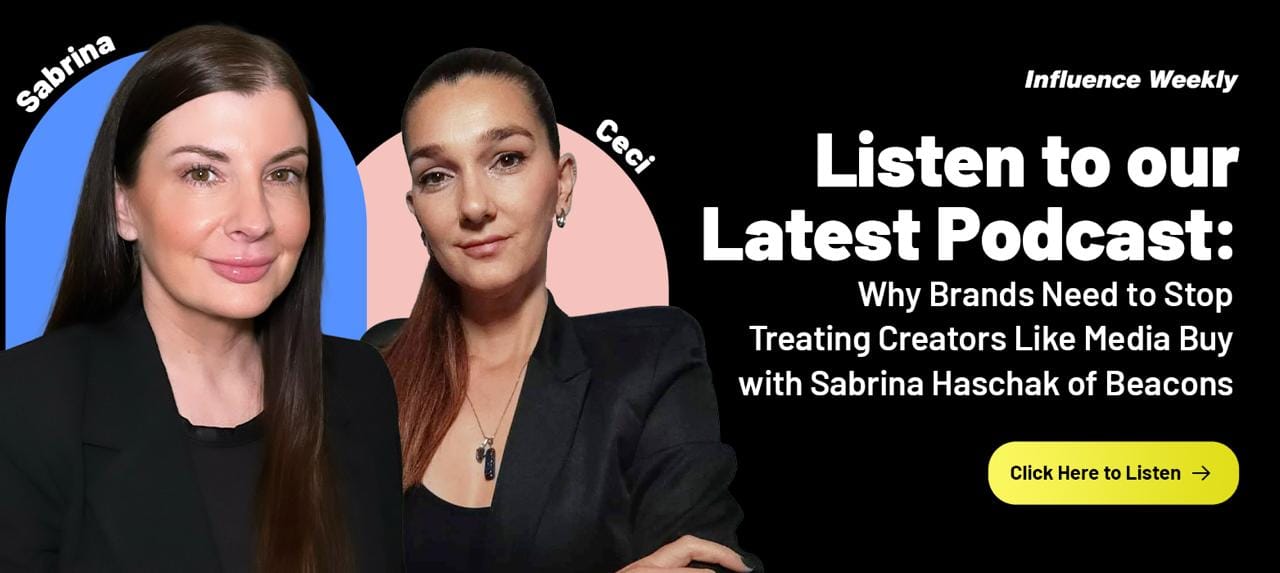
Ceci chats with Sabrina Haschak, Head of Partnerships at Beacons, to hear her perspective on three critical issues: why brands still struggle to measure creator marketing the same way they measure traditional media channels, what the most successful brand-creator partnerships have in common that others miss, and how creator pricing should reflect the reality that creators now function as full production companies. Tune in for practical guidance on treating creator marketing as a core channel, not an experimental budget line.
Campaign Insights
Samsung Electronics brought 140 influencers from 35 countries to San Francisco for its #TeamGalaxy Connect 2026 event from February 25, coinciding with the company's Galaxy Unpacked presentation to launch the Galaxy S26 Ultra smartphone and Galaxy Buds4 Pro earbuds. The three-day summit gave creators early access to both devices before broader media coverage.
Samsung organized content creation around three themes: camera, gaming, and sound. A #PlayGalaxy Cup gaming livestream featuring #TeamGalaxy influencers alongside North American e-sports organizations 100 Thieves and Offline TV recorded 16.77 million views.
Filmmaker Monique Yvonne produced a short film using the Galaxy S26 Ultra, with its trailer screened during Galaxy Unpacked. Individual creators focused on different features, with Mohamad Sofian creating visual effects content highlighting AI camera capabilities and Ry Velasco documenting the Buds4 Pro's audio quality across San Francisco locations. The summit concluded with awards recognizing top-performing content across camera, music, and gaming categories.
Domino's launched a social-first campaign ahead of March Madness featuring personal pizza customizations from creators, athletes, and college basketball players to promote its "Best Deal Ever" promotion. The campaign includes internet personality Trisha Paytas, influencer Courtney Cook, content creator Jesse Riedel, college basketball players Cameron and Cayden Boozer, JT Toppin, Olivia Miles, gymnast Jordan Chiles, and reality TV star Kelsey Anderson.
The pizza chain partnered with podcast "Friends Keep Secrets," featuring Benny Blanco, Lil Dicky, and Kristin Batalucco, for branded segments where hosts build pizza combinations using the promotion. The campaign extends the celebrity meal format popularized by McDonald's partnerships with Michael Jordan and BTS to social media influencers.
Domino's reported Q4 revenue of $1.54 billion, a 6.36% year-over-year increase. Its loyalty program reached 37.3 million members at the end of 2025, up 4.5% from the prior year. The campaign follows the company's first brand refresh in over a decade and mobile app relaunch as part of a broader push toward mobile ordering.
Vanity Fair launched four subscriber-only newsletters in March, covering technology, politics, fashion, and art. The newsletters include "A Billion to One" by Julia Black focusing on technology power and influence, "Party Animals" by Aidan McLaughlin covering Washington politics, "Fit Check" by José Criales-Unzueta on fashion industry players, and "True Colors" by Nate Freeman tracking art world deals and events.
The launch reflects a broader industry shift toward newsletter-based distribution models. The Washington Post announced a creator-led newsletter on beehiiv this week, joining Time, Newsweek, TechCrunch, and the Texas Tribune on the platform. Meanwhile, The Wall Street Journal, The Economist, The Financial Times, and The New Yorker are experimenting on Substack.
Beehiiv CEO Tyler Denk said publishers are transitioning from page views to owned subscribers as website traffic becomes unreliable. Vanity Fair hosts its newsletters on its own platform rather than third-party services.
The Toy Insider launched the PlaySquad Creator Network to connect family influencers with toy and game companies for paid brand campaigns. The platform requires no minimum follower count or membership fees, though all applications undergo vetting and only approved creators receive campaign invitations.
Accepted creators receive monetary compensation, free products, digital badges for cross-platform use, and access to an exclusive Facebook group. The Toy Insider manages all campaign logistics including payments, sample coordination, creative briefs, and approvals.
The launch builds on The Toy Insider's existing relationships with family and toy influencers through events like "Sweet Suite" and "Holiday of Play," but now formalizes and monetizes these connections. Toy companies can access the network through The Toy Book, The Toy Insider's sister publication, while creators apply directly through the company's website with applications reviewed on a rolling basis.
Brands shifted their approach to influencer gifting in 2026 as consumer skepticism toward lavish activations increased. Research from Socially Powerful found that despite 93% of marketers sending free products to creators, only 19% received meaningful brand advocacy in return.
Hair care brand Hair Syrup took fans instead of influencers to see Ariana Grande in a £13,000 VIP box at London's O2 Arena. The company focused on community engagement over traditional influencer partnerships after observing better reception rates. Little Moons reported an 85% organic posting rate from its gifting campaign for Chocolate Fudge mochi ice cream, which included custom accessories alongside products rather than simple product boxes.
Beauty brand Elemis emphasized educational content over advertorial posts, with chief brand officer John Mooney noting that "deep, meaningful storytelling" about skin science performed better than traditional promotional content. Sports drink Más+ by Messi worked with five global creators on a brand trip that generated 5.1 million impressions and 480,000 engagements. Companies measured success through engagement tracking and brand consideration metrics rather than direct sales conversion.
BDO Unibank won the Gold Anvil Award for Best Use of Influencer Marketing from the Public Relations Society of the Philippines, competing against more than 170 companies. The award recognized BDO's campaign featuring actor Piolo Pascual as brand ambassador, supported by comedian Small Laude and content creators Christian Antolin and Justine Luzares.
The influencers promoted BDO products under the Kabayan Connections program, which targets overseas Filipino workers and their families. They used storytelling techniques to simplify banking concepts and promote financial literacy.
BDO operates as the Philippines' largest bank by total assets, loans, deposits and trust funds under management as of September 2025. The bank maintains over 1,800 branches and more than 6,000 ATMs nationwide, plus 15 international offices across Asia, Europe, North America and the Middle East. BDO is part of the SM Group conglomerate and offers services including corporate banking, retail banking, remittances, and digital banking solutions.
Travel Destination Marketers Boost Influencer Budgets Even As Attribution Gaps Persist, Survey Finds
Steller, a travel marketing technology company, surveyed 200 destination marketing organizations and found 92% maintained or increased influencer marketing budgets in 2026. Forty-eight percent increased spending while 44% held budgets steady, with annual allocations ranging from hundreds of thousands to several million dollars.
Tracking attribution remained the top challenge, cited by 76% of respondents. While 84% of marketers track engagement metrics like likes and comments, 65% of stakeholders want economic impact data including hotel bookings and travel planning. Only 12% successfully track hotel bookings from social campaigns.
DMOs shifted focus from impressions to engagement as their primary metric, with 84% prioritizing engagement versus 28% emphasizing reach or cost-per-thousand impressions. Fifty-six percent cited finding and vetting creators as a secondary challenge, leading many organizations to bring influencer management in-house.
TikTok released research data demonstrating the effectiveness of its advertising platform for film marketing campaigns. The company partnered with Samba, a measurement firm, to analyze 38 theatrical campaigns from early 2023 through mid-2025 using Samba's Box Office Lift methodology that tracks millions of U.S. households.
The study found TikTok ads drove a median 172% lift in movie ticket purchase rates compared to audiences not exposed to the ads. Horror films performed particularly well, registering a 215% median lift in ticket purchases. TikTok campaigns generated a median incremental return on ad spend of $1.70, which the company claimed was 15 times more efficient than linear television advertising.
The research showed 60% of ticket purchases attributed to TikTok came from audiences not exposed to traditional TV advertising. Samba's methodology enabled deterministic matching between ad exposure and real-world consumer purchasing behavior. TikTok identified five top-performing creative formats: critic reviews, clear ticketing calls-to-action, film highlights, behind-the-scenes content, and creator-led content designed specifically for the platform.
Sony expanded its South African operations to target the country's creator economy and gaming market, according to Koji Sekiguchi, Head of Marketing for Sony Middle East and Africa. The company launched its Sony World e-commerce platform in South Africa to strengthen direct consumer relationships while maintaining partnerships with distributors and retailers.
Sony shifted from traditional influencer endorsements to co-creative partnerships with musicians, filmmakers, tech reviewers and lifestyle creators. The company organized experiential marketing events including the Sony Creators Convention, Alpha Festival and Sony Cine Tours to engage local audiences.
The electronics manufacturer focused on music and gaming sectors through its "For The Music" campaign featuring WH-1000XM5 and WH-1000XM6 headphones, and its INZONE gaming ecosystem. Sony introduced the ULT Power Sound audio range in South Africa and Nigeria, alongside LinkBuds Clip earbuds targeting younger consumers.
Sony partnered with creative arts institute Open Window, providing students access to professional CineAlta Burano cameras for training. The Sony Innovation Fund: Africa supports local entertainment sector growth in gaming, music and film production.
Check Out Our Media Kit

Interesting People
Kossi Tchenawou, known as "Plant Daddy," opened OnlyPlants, a Denver plant retail store and community hub, after building over 400,000 social media followers. The former RE/MAX corporate consultant left his real estate consulting role and launched the brick-and-mortar business in 14 days at Denver's Free Market at Dairy Block.
Tchenawou had worked as a business coach for RE/MAX franchises in Wisconsin and Indiana before testing digital marketing strategies on his own plant content. He reported quadrupling his social media engagement and income after leaving corporate work to focus on content creation full-time.
OnlyPlants operates as a community space hosting plant bingo, terrarium workshops, and Pilates classes alongside retail sales. The store currently operates near break-even, with Tchenawou's personal income still derived from social media rather than retail profits. He plans to expand OnlyPlants to multiple locations and develop proprietary products including soil and plant-care kits.
Forbes named Aaron Parnas to its 30 Under 30 media influencer list in December 2025, recognizing the 26-year-old political content creator who amassed 7.5 million followers across Instagram and TikTok. Parnas, a former civil litigator, built his following by posting straightforward news updates beginning with variations of "We have some news right now."
Vice President Kamala Harris selected Parnas to moderate the first stop of her "107 Days" campaign book tour at Manhattan's Town Hall venue in September 2025, bypassing traditional cable news hosts. Harris chose Parnas for subsequent interviews, including a February 2026 appearance on "The Parnas Perspective" following Trump's State of the Union address instead of appearing on CNN or MSNBC.
Parnas operates a Substack newsletter ranked number one in the news category and posts approximately 10 stories daily. His TikTok content accumulated nearly 600 million total likes. The son of Lev Parnas, who served 20 months in prison for campaign finance violations related to Trump's 2020 campaign, Aaron Parnas graduated law school at 21 and began creating political content in 2022 covering Ukraine's war.
Yamammi, a Dubai-based influencer marketing agency launched in 2024 by former corporate lawyer Shawn Munir, built internal technology to analyze creator audiences and match them with luxury and direct-to-consumer brands entering the Middle East market. The agency operates a database of approximately 10,000 creators globally, including 5,000 based in the UAE, focusing on micro-creators with 5,000 to 200,000 followers.
The company developed proprietary systems that segment creators by audience personas including wellness, fashion, lifestyle, travel, and hospitality. Brands using Yamammi's structured creator systems reported engagement increases of 3-13x compared to traditional campaign approaches, according to the founder.
Yamammi works primarily with premium D2C, luxury, wellness, and lifestyle brands expanding in the region. The agency manages creator sourcing, audience analysis, campaign execution, and performance tracking through its white-glove service model rather than offering standalone software. The UAE recently introduced advertiser permit requirements for influencers posting promotional content, adding operational complexity to creator marketing in the region.
British YouTuber KSI acquired a minority stake in Dagenham & Redbridge FC, a sixth-tier English soccer club, and commissioned a docuseries titled "Race to the Top" to chronicle the ownership experience. The series will debut on KSI's YouTube channel this summer and continue into the 2026/27 season.
KSI operates a YouTube channel with 17 million subscribers and maintains 33.5 million followers across all social platforms. After Party Studios is co-producing the series, which will be dubbed into 14 languages globally. Director Ben Doyle, known as RVBBERDUCK, previously worked with KSI on the 2018 documentary "KSI: Can't Lose."
The project follows the model established by actors Ryan Reynolds and Rob McElhenney, who purchased Wrexham AFC in 2021 and documented their ownership in the Disney+ series "Welcome to Wrexham." The docuseries will provide behind-the-scenes access to boardroom meetings, fan reactions, and daily club operations as KSI manages his new investment.
Gold Studios Group, a London and New York-based creator economy company, expanded its operations to encompass five divisions since its 2020 founding. CEO Eddie Gold built the company from initial commercial production services into a multi-faceted business now representing more than 400 creators across comedy and sports verticals.
The company operates Gold Talent for creator representation, Gold Live for comedy tours and live events, Gold Originals for platform-specific programming, a creative agency division for branded entertainment, and the recently launched Gold Arena for sports creators. Gold Studios opened a dedicated production studio in Camden, London, designed for daily content creation cycles.
The company partnered with betting brand Betway to launch ten YouTube channels alongside corresponding TikTok, Instagram, Facebook and Spotify presences. Gold Studios also developed subscription offerings, including Extra Tugg for comedian Big Tugg, priced at $4 monthly for content exceeding YouTube's restrictions, attracting thousands of subscribers. The company grew to approximately 50 employees while maintaining what Gold describes as an "11-star service" operational philosophy.
Influencer Kay Dudley, one half of the duo Kay & Tay Official, launched nutrition brand HEYNU with its debut product HEYBAR on February 27. The plant-based protein bar originated from a homemade protein ball recipe Dudley shared online that generated audience demand for a commercial version.
HEYBAR contains 14 grams of plant-based protein, 6 grams of fiber, and 5 grams of sugar per bar. The gluten-free bars include 21 essential nutrients from a plant nutrient blend and are formulated without nine allergens, though manufactured in a facility that processes at least one allergen.
The launch includes three flavors: Oatmeal Chocolate Chip, Chocolate Sea Salt, and Lemon. HEYNU plans retail expansion through Summer 2026. The brand positions itself as targeting everyday on-the-go consumption, representing another example of creators monetizing audience engagement through direct-to-consumer product development based on community feedback.
Industry News
Nonsensical, a Birmingham-based TikTok-focused agency founded in 2017, hosted its sold-out TikTok Sauce conference in London on March 4, bringing together social media leaders from BBC, Channel 4, British Vogue, and Wimbledon. The full-day event focused on organic TikTok growth strategies rather than paid advertising, addressing how brands can build sustainable visibility on the platform.
CEO Oli Hills emphasized shifting from viral content to "social shows" - repeatable content formats that function like television programming. Examples included Eliza's street fashion guessing games and Wimbledon's "Overheard at Wimbledon" series. Hills argued that brands achieving 70% return viewer rates with consistent formats generate more brand recognition than one-off viral videos.
The conference highlighted organizational challenges brands face implementing TikTok strategies, particularly around TikTok Shop integration requiring cross-department coordination. Hills noted that social media teams often understand platform mechanics but struggle with internal approval processes that slow content production needed for discovery-driven commerce success.
**** Fox Entertainment hired Billy Parks to head its new Fox Creator Studios division, which partners with digital creators on content relevant to the network's programming. Parks previously served as an operating partner at The Chernin Group and venture partner at Slow Ventures Creator Fund, a venture capital firm focused on creator economy investments.
Parks brings experience from creator-focused companies including Otter Media, Fullscreen, and Astronauts Wanted. He will report to Fox Entertainment CEO Rob Wade and focus on expanding the division beyond its initial deals.
Fox Creator Studios launched with partnerships in food content, securing deals with Gordon Ramsay through Studio Ramsay Global, Rosanna Pansino, Jolly, Sorted Food, The Food Theorists, and Little Remy Food. The announcement occurred in March 2025, though the specific financial terms of these partnerships were not disclosed.
The move represents Fox's entry into direct creator partnerships as traditional broadcasters seek new content sources and audience engagement strategies in the digital landscape.
The NBA brought 200 creators to its All-Star Weekend in Los Angeles in February, providing behind-the-scenes access to drive engagement with younger audiences. This reflects broader growth in creator marketing as brands increasingly partner with digital influencers to reach Gen Z and Gen Alpha consumers who consume less traditional media.
YouTube creator Jesser, who has 37.5 million followers, now commands six- and seven-figure advertising deals. NBCUniversal partnered with influencers Allison Kuch and Isaac Rochell for Olympics and Super Bowl coverage through February 8.
Talent agencies have expanded creator divisions, with CAA hiring former UTA executive Brent Weinstein in 2025. Support firms like Studio71 represent approximately 1,000 creator channels, while Jellysmack operates as a holding company for creator businesses including Dan Abrams' Law&Crime network.
WME reports that YouTube crossed 50% TV viewing versus mobile consumption, enabling creators to bypass traditional networks. Gaming creator PrestonPlayz leveraged his 17 million YouTube followers into merchandise lines and live events, while Rhett and Link operate Mythical Entertainment with over 100 employees producing daily content shows.
Podstock, a podcast analytics company, launched Agent on March 10, an AI-powered assistant integrated into its platform to automate analytics and campaign operations for podcast networks and advertising teams. Agent serves as an analytics assistant that answers performance questions using Podstock data and handles operational tasks including onboarding new shows, building inventory calendars, and generating media plans based on advertiser requirements.
The AI tool can identify and book inventory meeting specific campaign criteria across multiple shows and time periods. Agent operates in separate environments for each organization, with configurable access controls and audit logging for system activity and workflow execution.
Podstock offered Agent at no additional cost to existing customers and new customers signing up during the preview period. CEO Michael Paretzky stated the tool aims to reduce manual work for podcast operators. The company indicated Agent represents the first in a planned series of AI tools to be developed with podcast business partners.
PRX, AudioUK Bring Podcast Creator Summit To London, Expanding Effort To Support Emerging Podcasters
PRX partnered with AudioUK and Apple Podcasts to host the Podcast Creator Summit in London on February 6, 2026, marking the first international expansion of the creator education program. The free event took place at Apple's Battersea Power Station offices and targeted emerging podcasters rather than established media companies.
PRX, a public media company, led event logistics while AudioUK, a UK industry body that operates the Audiotrain skills platform, managed speaker recruitment and programming. Apple Podcasts provided the venue and contributed to planning. Sessions focused on monetization strategies, artificial intelligence applications, and video podcasting adoption.
The summit addressed barriers facing independent creators in an increasingly competitive market dominated by large media companies and celebrity shows. Programming included workshops on audience growth, brand building, and revenue generation through subscriptions, sponsorships, and merchandise.
AudioUK's Audiotrain platform offers free video training modules covering podcast production and business strategy, supported by BBC funding, and hosts networking events across Cardiff, Manchester, and Edinburgh.
Dubai's state-backed Creator HQ attracted over 50,000 content creators to the emirate, offering residencies, legal support, and favorable tax rates of 5% VAT on UAE income over $102,000 and 9% corporate tax on income exceeding $272,000. When Iranian strikes hit Dubai tourist destinations including Fairmont, The Palm hotel and Burj Al Arab hotel in March 2026, influencers launched coordinated responses praising the UAE's safety and leadership.
Julia E, an 18-year-old German influencer with 60,000 followers, posted viral "Are you safe?" content after witnessing explosions, denying payment for positive posts. The UAE requires influencers to obtain advertiser permits costing up to $4,000 and avoid content harming foreign relations. Public Prosecution warned of legal accountability for sharing unverified information following the attacks.
Tech executives Pavel Durov and Elon Musk publicly supported Dubai's safety claims during the crisis. The UAE targets creative industries contributing 5% of GDP by 2031 as part of economic diversification from hydrocarbons, though wealthy residents fled the region as the Iran conflict escalated.
The global travel content creation market, valued at $6.1 billion, is projected to reach $17.2 billion by 2033, and niche creators are capturing a growing share of brand deals and audience trust. With 78% of Americans citing influencers in travel decisions, creators who combine specific formats with transparent storytelling are outperforming generalist accounts.
Kevin Droniak built his following documenting 24-hour trips, often flying economy and paying his own fares. Andrea Giordano runs a deal-focused email list targeting Nashville-area travelers, turning a single Icelandair route launch into 100-plus bookings. For brands, these micro-niches offer defined, high-intent audiences that broad campaigns cannot replicate. As the space grows more crowded, credibility and niche expertise are becoming the primary drivers of creator revenue and partnership value.
Roblox launched two creator support programs on March 11, targeting developers who can build games for the platform's growing adult user base. The Roblox Incubator accepts up to 40 experienced teams for six-month, milestone-driven development cycles, while Roblox Jumpstart operates on a rolling basis for newer creators or those exploring different game types.
Both programs provide mentorship, expert access, and user acquisition support. Applications opened March 9, with pitches beginning at the Game Developers Conference. The company prioritizes games introducing new genres, gameplay mechanics, or visual styles to the platform.
Roblox reported that 27% of age-verified daily active users are over 18, with the 18-34 demographic growing over 50% year-over-year in the U.S. The platform currently reaches fewer than 10% of U.S. adults aged 18-34 daily. Roblox identified content gaps in RPG, strategy, and shooter games, which remain underrepresented despite strong demand from older users seeking deeper gameplay experiences.
ShopMy has crossed $1 billion in annual transactions, cementing its position as a major player in creator commerce. Founded in 2020 by Tiffany Lopinsky, Harry Rein, and Christopher Tinsley, the platform lets creators earn 10 to 30 percent commissions on product recommendations while giving brands a managed influencer marketing channel. The company now serves 243,000 creators and 1,600 brands.
Last fall, ShopMy raised $70 million at a $1.5 billion valuation, with backers including Bain Capital Ventures, Bessemer Venture Partners, and influencer-investors Sofia Richie and Aimee Song. Lopinsky, who built her own food influencer account at Harvard before pivoting to tech, serves as president. ShopMy competes directly with LTK, the affiliate shopping incumbent founded in 2011.
Dolphin Entertainment Inc., the entertainment marketing company founded in 1996, partnered with capital-raising platform DealMaker to help creators fund consumer product businesses. DealMaker has facilitated over $2.4 billion in capital raises through equity crowdfunding and has become a leader in Regulation CF offerings for companies seeking under $5 million.
The partnership addresses a funding gap for creators launching businesses. According to Dolphin CEO Bill O'Dowd, consumer products typically require $2-5 million to launch, with additional funding needed for scaling. Dolphin operates marketing agencies including 42West, The Door, and Shore Fire Media, working across entertainment and creator economy sectors.
Under the model, Dolphin develops business plans with creators over four-week periods, evaluating product concepts and marketing opportunities. The company then uses its corporate relationships with brands like Crocs, H&M, and Keurig Dr Pepper to support distribution while DealMaker facilitates fundraising campaigns. The partnership allows creators to raise capital directly from their audiences through regulated online investment offerings rather than relying solely on traditional venture capital.
Edelman Executive Vice President Brooks Miller outlined how creators have evolved from marketing channels into independent voices shaping public discourse, creating what she called a "creator opinion layer" of the internet. Miller leads creator marketing at United Entertainment Group, managing campaigns for Samsung, Starbucks, and American Express.
Miller, who previously spent seven years building Twitter's creator marketing operations, noted creators increasingly reject brand partnerships that conflict with audience expectations. The shift reflects growing creator independence through diversified revenue streams including affiliate links, Patreon subscriptions, and podcast advertising.
Edelman developed a Creator Trust Score system to vet potential partners across risk factors. Miller recommended brands build deeper partnerships with fewer creators rather than pursuing scale-focused campaigns with hundreds of participants.
The agency expanded creator roles beyond sponsored content to strategic consulting, including brief reviews and script editing. Miller cited healthcare brands consulting menopause-focused creators for authentic messaging. She identified business-to-business marketing as an emerging opportunity, particularly on LinkedIn's expanding video platform.
Registration Required
Meta has acquired Moltbook, a social network built exclusively for AI bots, for an undisclosed sum. Creator Matt Schlicht and co-founder Ben Parr will join the Meta Superintelligence Lab. Schlicht launched Moltbook in January after prompting an AI agent to build its own social network. Within days, more than 10,000 bots were active on the platform, drawing attention across Silicon Valley and accelerating industry interest in AI agents.
The platform runs on open-source software called OpenClaw, originally developed by Peter Steinberger, who was separately hired by OpenAI. Meta says the acquisition supports its push to develop "secure agentic experiences." The deal signals growing competition among major tech players to commercialize AI agent technology at scale.
Patreon CEO Jack Conte criticized AI companies for failing to compensate individual creators whose content gets used to train artificial intelligence models. In an interview with Business Insider, Conte said creators are being "left out" while AI companies like OpenAI and Meta strike licensing deals with traditional media companies.
Conte posted a 45-minute video on Patreon Tuesday outlining his stance on AI and the creator economy. He called for regulation to protect creators who lack leverage to negotiate with tech companies directly.
In 2025, Anthropic agreed to pay a $1.5 billion settlement to authors after a federal court ruled the company's use of pirated books without consent did not qualify as fair use. Conte suggested a system similar to YouTube's Content ID, which allows rights holders to detect and monetize unauthorized use of their work.
Bloomberg reported last year that AI companies including startup Moonvalley paid creators to license unpublished content. OpenAI hired Meta's former head of partnerships who managed celebrity and creator relationships.
YouTube is launching a pilot program allowing government officials, political candidates and journalists to detect and report AI-generated deepfake videos of themselves. Participants must submit a video selfie and government ID to enroll, then access a dashboard showing detected content and flag videos for removal. AI-generated content is not blocked at upload, but can be taken down after detection, with exceptions for parody, satire and public interest content.
YouTube says identity data will not be used to train Google's AI models. The move comes as deepfake technology improves rapidly and platforms face mounting legal and regulatory pressure. Researchers warn detection tools remain imperfect and removal speed is critical, particularly around high-profile political events where misinformation spreads quickly.
Business Insider surveyed venture capitalists to identify 17 creator economy startups to watch in 2026, as AI transforms content creation and social platforms evolve into e-commerce hubs. Agentio, which automates creator ad campaigns using AI, closed a $40 million Series B round in November and secured $56 million total funding from Forerunner and Craft Ventures.
Several AI-powered companies made the list, including Suno, which generates songs from text prompts and raised $375 million, and Delphi, an AI chatbot platform for creators that secured $19 million in funding. Commerce-focused startups dominated recommendations, with ShopMy valued at $1.5 billion after facilitating over $1 billion in annual sales through its affiliate marketing platform.
Whatnot, the live shopping platform, achieved an $11.5 billion valuation after raising $490 million in 2025. Digital marketplace Whop reached a $1.6 billion valuation with $277 million in total funding. Other notable companies include Fal with $300 million raised and Opus Clip with $50 million for AI video editing services.
Podcasters who moved their video content exclusively to Netflix are seeing YouTube subscriber growth fall by as much as 50% compared to the same period last year. Barstool Sports' Spittin' Chiclets dropped from 10,000 new YouTube subscribers in February 2025 to 5,000 this year. Football show 3 & Out With John Middlekauff saw February subscribers collapse from 1,900 to 200. A key factor:
Netflix contracts limit how many clips creators can post to third-party platforms. The stakes are significant given YouTube claims over one billion monthly podcast viewers in the U.S. Netflix has over 300 million subscribers globally but has not disclosed podcast engagement figures. Creators evaluating similar deals must now weigh guaranteed cash against potential long-term audience erosion outside the platform.